The context
Gartner have reported that “80% of Today’s Project Management Tasks Will Be Eliminated by 2030 as Artificial Intelligence Takes Over”. Yet the penetration of AI within the construction industry has been slow. We believe that the key reasons for this are:
- A lack of understanding of advanced data analytics.
- A lack of quality data and consistency. Much of it exists in silos.
In 2018 Sir Robert McAlpine (SRM) recognised the opportunity to leverage the exhaust plume of data that emerges from their projects to develop a bespoke planning tool to use the power of artificial intelligence (AI) as well as making the information more accessible for all team members.
The challenge
Successful programming for a project is an art as much as a science. A detailed programme is developed by a project planner which is exported in various versions to different audiences. The accessibility of the data is often limited, and is quickly outdated. Queries are made in an ad hoc fashion using the planner to show a view or a list of tasks that a certain manager is interested in. This workflow creates a friction in accessing the information resulting in project teams often not carefully following the programme.
This creates significant project risks, impacting the ability to deliver projects on time, to budget and to a sufficient quality. Better engagement is required around the project programme, making it an accessible tool for all within the project – from project manager, to package managers, suppliers and subcontractors.
What changed
SRM hired us to create an improved programming application, making it more user friendly, visual and accessible, using live data. Using Microsoft Power BI, we took the full extract of the dataset on a periodic basis, and with the data in its raw form, we created standard visualisations that satisfied questions that would be asked on an ongoing basis by various managers. The initial question set included:
- Which Critical Path Activities are happening now (broken down by zone/floor)?
- What activities are scheduled to complete in the next 2-6 weeks? Of those, which activities are behind schedule?
- What are the biggest risks and delays on site?
- On a plan, where should my contractor be floor-by-floor?
- What are the upcoming release dates for design/procurement?
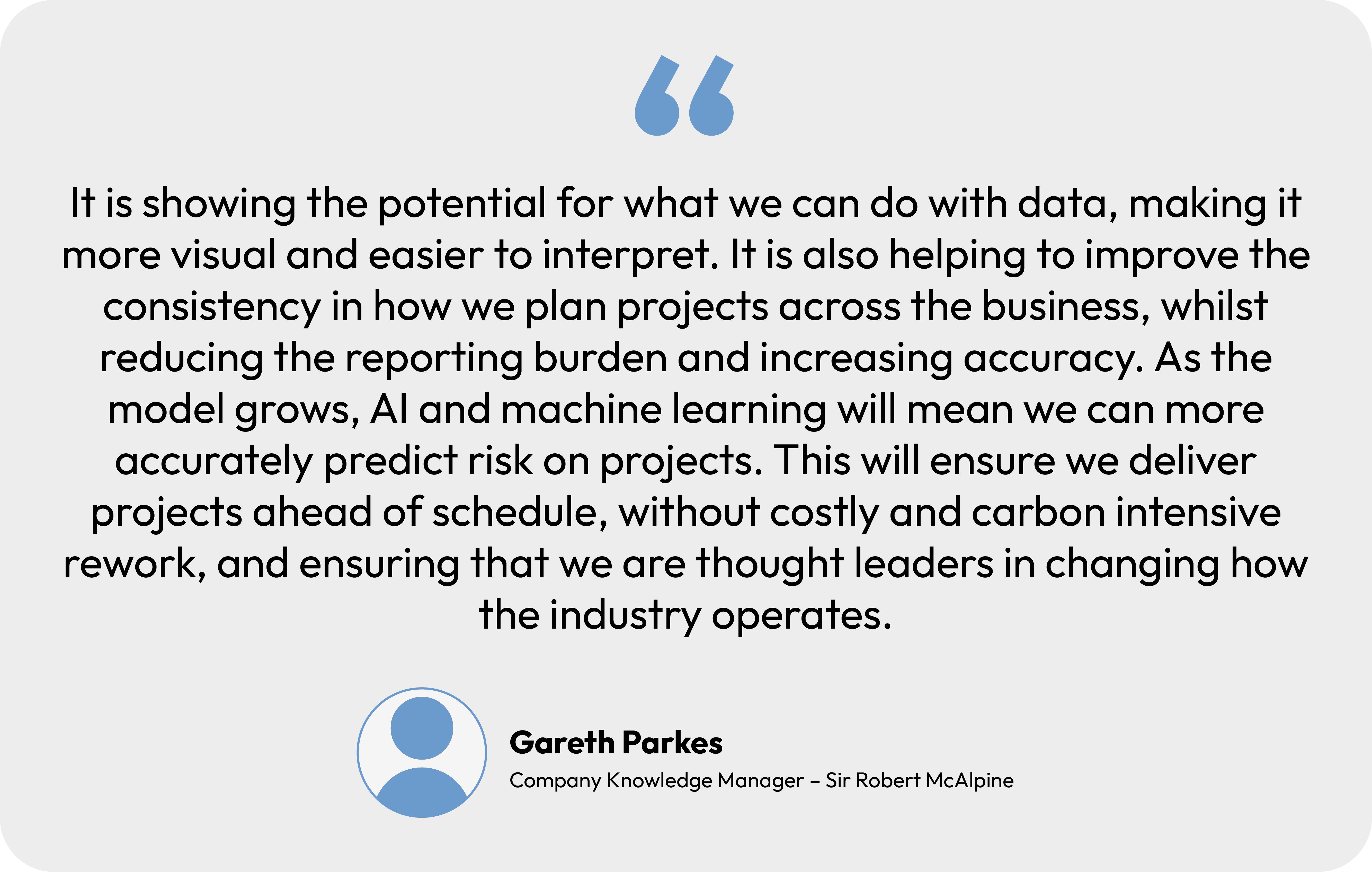
Our new tool answered these questions by visualising the dataset in a user-friendly way. Typically the main audience for a construction programme is limited to the project manager, and the project planner. Our tool showed that 14 people on the project, over half the team, logged in and actively engaged with the programme, a significant improvement over a typical project.
As part of collaborative planning on the project, subcontractors were engaged on the project programme using the live interactive interface that had been developed. The subcontractors proposed construction programmes were integrated into the Master Strategic Plan, and then uploaded into the model. This then facilitated the communication of the critical path, procurement and supply chain risks, and package or subcontractor coordination requirements.
The 2-week look-ahead feature was specific to the package managers, allowing them for the first time to focus in on just their packages, and where they should sit within the programme. This allowed for much closer collaboration with suppliers and their delivery against their programmes.

Outcomes
The solution yielded real results, with a number of value-adding benefits including:
- A clear initiation of recovery plans by providing visibility of programme slip information.
- Retained focus on upcoming deliverables by providing consistent access to priority activities.
- Prevented on-site work area clashes by highlighting work areas visually.
- Programme data available to anyone on the project.
The renewed focus on which activities matter led to reductions in on-site clashes and shortened programme timescales which led to an indirect reduction in emissions where the overall construction lifecycle is concerned.
Next steps
At the time, the next steps of this initiative were summarised in two elements. The first was broadening the data being analysed and integrating the datasets together by mapping them in as many ways as possible.
The second step was to roll out the analytics across the entire project portfolio to gather enough data to facilitate predictive analytics.